Trust is an
audit trail.
We ran one shipped finance agent seven times without changing anything, and its score moved by 18 rubric criteria. Measured against that noise, under rules written in advance, an optimization loop cut the agent’s bill to 0.34× on held-out questions, while a 14-point accuracy gain on development questions did not hold.
Can You Trust Your Finance Agent? Drift, Diagnosis and Auditable Intervention on One Shipped Financial Research Agent · arXiv:2611.17939

- 105–123
- of 149 criteria passed in seven identical runs of the same agent
- 13 / 20
- failures owned by the agent’s instructions; the model owns 4
- 75 / 80
- cases where a blind reader names the same fault as the analyzer
- 0.34×
- the baseline’s cost on held-out questions, 95% CI [0.22, 0.58]
01What a score leaves out
A financial research agent is in production, and it has a leaderboard score. A compliance officer asks what it does when it is wrong. The score can’t answer. It was computed once, on questions the officer has never seen, by a grader the institution does not control. It says nothing about where the wrong answers came from, or who in the building should fix them. §1
We took the reference agent shipped with the Vals Finance Agent Benchmark v2, left it untuned, and asked four questions in order. Each one picks up what the previous one leaves open. §1
This is a case study of one agent. Nine test questions and twenty failed trajectories give an anatomy, not population shares, and every test interval is a paired bootstrap over those nine questions. We don’t claim a better agent, a general method, or comparability with any leaderboard. §1, §7.1
02One agent, as shipped
The benchmark ships a runnable agent: a tool-calling loop over Claude Sonnet 4.5 with 7 tools and a 2,767-character system prompt. We wrote none of it and tuned nothing by hand. The one substitution is a backend: the agent’s EDGAR search relied on a paid third-party index, which we replaced with the SEC’s own full-text search behind the same tool name, description and arguments. On one run’s queries, replayed on both, the target company’s main filings came back from both in 81 of 81 cases. §2, Appendix E
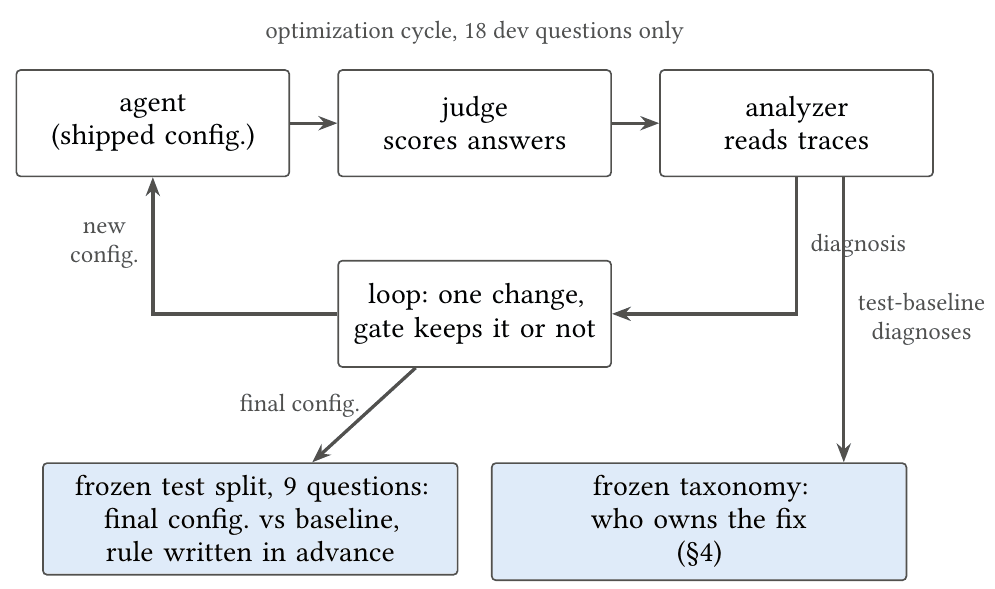
Around these components sits the protocol: the set of freezes, replicas, written rules and test openings in Figure 1. The files it produces are the audit trail. Both matter more to this paper than any single score. §2
03The score is a draw
Before asking whether a change helped, we measured how much the agent moves on its own. We ran the shipped configuration seven times on the 18 dev questions and scored every run with the same judge. Criteria passed ranged from 105 to 123 of 149: 18 criteria, twelve points of pass rate, with nothing changed. A score is one draw from a distribution, not a property of the configuration. §3
The movement runs deeper than the totals. Between two consecutive runs, 15 to 28 criteria flip. The bill moves by up to 17%, and a single question cost anywhere from 0.16× to 5.43× what it had cost the run before. Runs 6 and 7, back to back, scored 116 and 109. The test split drifts the same way: its three baseline replicas passed 54, 56, 61 of 90 criteria. §3
This matters to anyone who promotes a change. The loop’s default bars, a 5% cost cut or a 1-point accuracy gain measured on a single run, sit inside this drift. Averages hide it too. Between runs 3 and 4 the total bill moved by less than 1%, while per-question cost ratios ran from 0.16× to 2.52×. On baseline 3’s measured costs we built a change that makes the twelve cheapest questions 30% cheaper and the three dearest 60% dearer. A geometric-mean gate scores it 0.853 and approves it, while the bill rises 11%. §3
One failure in the drift has a compliance name. The agent parses the wrong fiscal period’s filing: for one dev issuer, AMZN, in 6 of the 7 baselines, and for three others depending on the draw. It is a property of the run, not of the configuration. §3
04Who owns the fix
In an institution, different people fix different things. Compliance rewrites the agent’s policy, the platform engineer owns the tools, the data owner the retrieval pipeline, and model risk the model. So we classify each failure by the owner of the remedy: the layer whose owner would fix it, not the symptom it shows. §1, §4.1
The analyzer doesn’t speak this vocabulary. It labels each failure with a fix_level and a harness_component, and we map that pair onto the four layers with a fixed table, frozen before the analyzer saw any test trajectory. One cell needs a rule. A failure counts as model only if the analyzer names no missing or wrong instruction, and the decisive step is the model’s own reasoning or output, with the facts it needed already in context. Otherwise it is policy. Model is the residual: the case that a model swap, and no harness change, would fix. We call this Rule M. §4.1
The pre-registered set is the three baseline replicas of the test split: 27 trajectories, 20 of them failed. Thirteen of the twenty are owned by whoever writes the agent’s instructions. Three belong to the tools. Four, one in five, would be fixed by a different model and nothing else; five under a stricter sensitivity reading. Under either reading the model is the minority owner, for this agent. §4.2
The zero in the data column needs care. A stale-filing failure does occur in these traces: in one replica the agent parsed the FY2024 10-K while the FY2025 10-K sat in the same search result. It lands in policy, because the remedy the analyzer names is an instruction to check the period. Retrieval failures go to data only when the material could not reach the context. When the agent simply did not look, the owner is the policy. The zero is a property of the projection and of this agent, not evidence that retrieval never failed. §4.3
The same question can also fail differently from run to run. PFE is policy three times. CZR is tool, policy, tool. VSEC is model, policy, policy. Part of that is the agent failing in different ways, and part is the instrument, which the next section takes apart. §4.3
05Checking the diagnosis
The count is only as good as the analyzer that produced it. We checked it blind, against readers that never saw its output, and against itself. Three separate things are being checked: what failed, where in the trace, and which layer owns the remedy. They come out differently. §5
Four readers from three model families (Claude Opus 5, Gemini 3.1 Pro, Gemini 3.8 Flash and GPT-5.5) each received the same 20 failed trajectories: the question, the failed criteria and the numbered trace, and nothing from the analyzer. Each named the decisive event and the fault. The protocol, including how “same fault” is decided, was written before the panel ran. §5.1, Appendix D
What failed is corroborated. The analyzer names the same fault as a blind reader in 75 of 80 cases. The readers agree among themselves in 112 of 120. Every one of the 20 trajectories has its fault confirmed by at least three of the four readers. §5.1
Where is looser, on both sides. The analyzer’s decisive event is within five trace events of a reader’s in 45 of 80 pairs; the readers are within five of each other in 84 of 120. The analyzer is as good as an independent reader at saying what went wrong, and about as imprecise at saying where. §5.1
Which layer is a definition, not a perception. Asked to place each fault in our four layers, the readers said model in 66 of 80 labels and policy once. In 12 of its 20 labels, Claude Opus 5 quotes a violated instruction and still writes model. The readers answered who erred; our table answers who owns the remedy. That reading is ours, and it is not the one a model gives unprompted. Given the rule, it is reproducible: a second reader with Rule M, the trace and the decisive index, and none of the analyzer’s prose, returned the same verdict on all 8 cells where the rule applied. §5.1
The analyzer also makes mistakes of its own, and we list them. Two are worth telling in full. §5.2
The analyzer wrote that correcting one decision point would flip every downstream EBITDAR, growth and CAGR check. A sister replica had made that decision and still failed all 8 checks. Three replicas took three different bases for the same figure, and each was 0.6–2.1% off against a 0.5% tolerance.
A reviewer reading one trajectory would have believed the analyzer. The replica did not.
ASPI never passes its must-pass criteria. The analyzer flags it as a data issue and one reader calls it a benchmark artefact: it asks for the gross margin between 2/28/2024 and 2/28/2025, and ASP Isotopes reports on calendar years.
Those periods belong to Renergen, which ASP Isotopes agreed to acquire, and whose audited statements it filed as an 8-K exhibit. They reproduce the rubric: depreciation in cost of sales rises from R1.5 million to R34.2 million, and the gross margin falls 88.62 points. In one replica the agent’s own search returned that exhibit at event 39, and at event 40 it chose other figures. The failure is the agent’s.
The analyzer is also unstable. Given a byte-identical payload twice, it returned 9 categories once and 8 the next. The layer distribution barely moved, but the instability reaches the count through one field. In one replica it attached a verification component to three of its four prompt findings, Rule M applied only to the fourth, and the model count was zero. In another, six of eight carried no component, Rule M fired, and the model count was three. Replayed twelve times over one dev run, it placed the same AMZN stale-filing failure under four different fix levels. §5.2, Appendix C
What this section supports is bounded. The analyzer is corroborated on what failed. The layer is our definition, and it is reproducible across model families when the rule is given. The instrument’s failure modes are known: it over-claims counterfactuals, it is unstable on the harness-component axis, and it names the same fault inconsistently. §5.2
06One loop, two objectives
We ran the loop as shipped on the 18 dev questions twice, once to cut cost and once to raise accuracy. Each round the analyzer reads the traces of the current run. The loop picks one finding, proposes one change on one lever and states the trace evidence the change answers. The dev split is re-run once and a gate compares the new run with its parent. A session stops after 5 rounds or two consecutive rejections. §6
The gate reads one run, and the previous sections show how far one run moves. It filters changes; it does not prove them. What the loop guarantees is that every change answers something observed in a trace. Whether the change works is left to the test. §6
Cost. The analyzer found the nested retrieval call at 74–96% of the cost of every question it sampled. Round 1 moved that call, a document extraction, from Sonnet 4.5 to Haiku 4.5: the bill fell to 0.437× its parent, from $31.79 to $13.90. The agent was also querying the same stored document three to eight times, so the loop asked it to batch its sub-questions into one call per document. Written into the tool description, that saved almost nothing (0.996×) and was rejected. Written into the system prompt, the same instruction cut the bill to 0.843× and was kept. Round 5 added one sentence: after two or three empty EDGAR queries, pivot to an 8-K exhibit or web search (0.898×, kept). §6.1, Table 7
The same instruction saved nothing as a tool description and 16% of the bill as a system-prompt line. In this agent, the layer, not the wording, owned the remedy. §6.1
Accuracy. Every change the loop chose was a system-prompt paragraph. Round 1 added scope qualifiers and gained seven criteria, which is exactly the distance between unchanged runs 6 and 7; the gate promoted it. Round 2 answered five dev traces in which the agent had the right figures and chose the wrong scope of an ambiguous term: gross against net interest, all cash against cash above the required minimum, equity price against enterprise value. It added five rules for these ambiguities and reached 130 of 149, above every one of the seven shipped baselines. The gains sat where the rules pointed: TGT/WMT went from 3 to 8 criteria, EPAM from 2 to 5. §6.2
Then the loop stopped. Both rejected rounds kept the round-2 rules, and scored TGT/WMT 3 of 8 both times and EPAM 2 and 1 of 5. Before the test ran, we wrote down that 130 was one draw of a configuration whose level was unknown. §6.2
Before either winner went to test, we read every promoted prompt change for leakage: no company, ticker, figure, date or specific filing may appear. Both passed, with one declared exception. The accuracy winner’s second paragraph carries one example figure, “79 million shares”, that names no issuer. §6, §6.2
07The frozen test
Each arm sent one configuration, its own final one, to the nine frozen test questions: three replicas against three baseline replicas, under a decision rule written before the test was opened. A saving is real only if the whole 95% interval of the cost ratio lies below 0.83, the widest ratio between two unchanged dev runs. An accuracy gain is real only if its interval lies above zero. A sign-flip p-value is reported beside it, and never used to rescue an interval that includes zero. §6.3, Appendix D
The cost winner spends 34% of the baseline: 0.341×, with a 95% interval of [0.216, 0.580], entirely below the noise band. Its pass rate is within noise of the baseline (−3.7 points, [−8.9, +1.1]). Almost all of the saving is on the nested retrieval side: $62.91 of the baseline’s $71.17 was nested-model spend, against $15.11 of the winner’s $24.27. §6.3, Table 9
Per question, the disclosure question on PFE fell from $22.34 to $3.95 over three replicas. CRM, the financial-modelling question, is the one the winner makes dearer: the agent spends 129 turns and 114 single-operation calculator calls on it, the defect the rejected round-4 change had targeted. CZR and ASPI are unsolved by every configuration. The round-3 configuration, declared in advance as a secondary, returns the same verdicts: a real saving (0.397×) at a pass rate within noise. §6.3, Table 10
The accuracy winner gained 4 criteria of 270. Its +14 points on dev became +1.5 on held-out questions, with an interval of [−5.3, +7.2] and a sign-flip test at p = 0.74. Its cost is within noise too (1.082×). The two paragraphs written on dev cases did not carry to nine questions about other issuers: VSEC lost criteria in all three replicas, and CRM gained five, then none, then lost four. §6.3
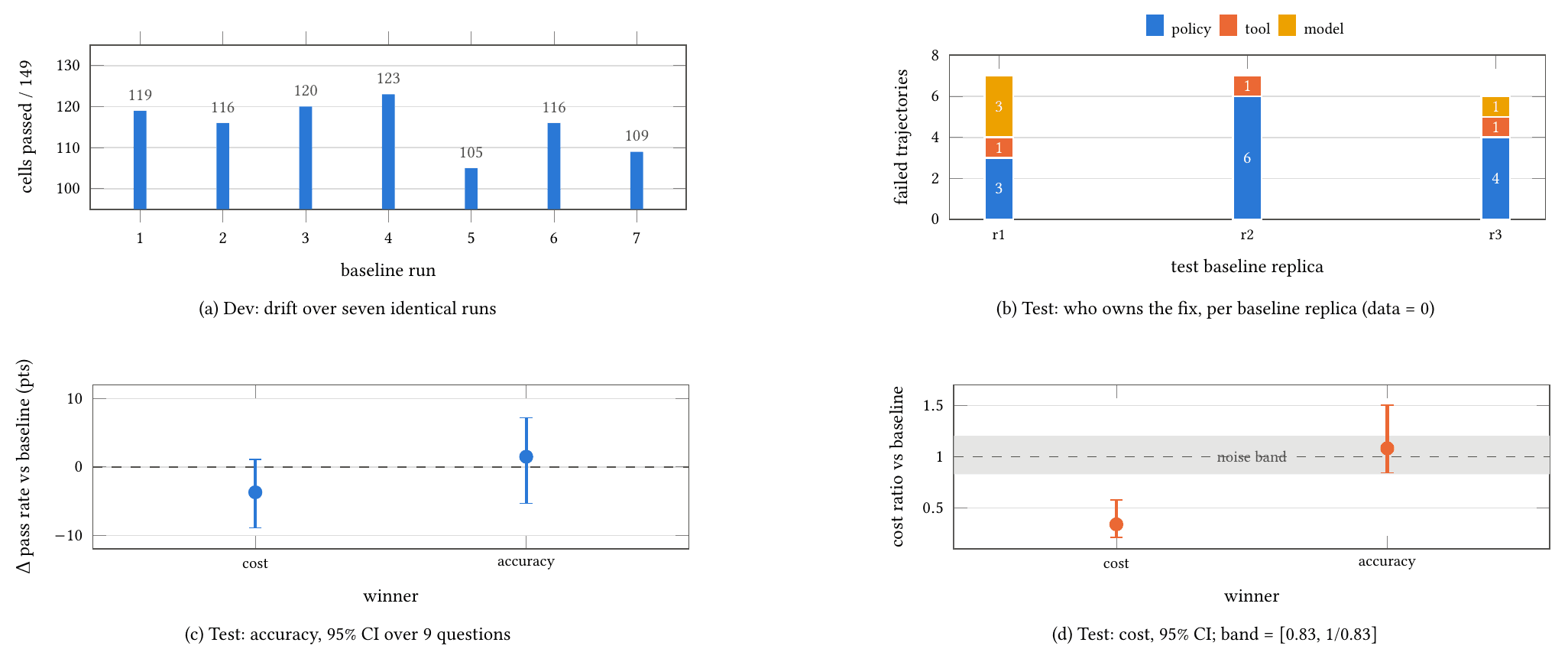
Same loop, same judge, same split, same rule: one pass and one fail. The structural remedy, a cheaper nested model and an instruction about how to use a tool, survived questions the loop had never seen. The case-specific remedy, two paragraphs about ambiguities in particular dev questions, did not. Without the drift measurement and the written rule we would have reported “+14 points on dev”, and it would have been true and worthless. §6.4
Two boundaries apply. The cost result is consistent with the diagnosis having pointed at a real remedy, but it does not isolate the diagnosis: the loop has no control arm, and the test split is now closed, so none can be added. And cost is the axis on which our instruments have resolution, 0.341 against a band of 0.83. On accuracy, the band is the result. §6.4
08Trust is an audit trail
We set out to ask whether a shipped finance agent can be trusted, and we answered with measurements rather than a cure. Each answer above is tied to a file the protocol produced: the seven baselines, the frozen taxonomy, the panel protocol, the written test rules. Trust, on this evidence, is the trail that lets a reader check each claim against a file. §7, §8
A practitioner can build that trail with nothing from us. It takes four habits. §8
09Where it falls short
The paper states its limits plainly, and so do we. §7.1
- Not comparable with the leaderboard. Our judge scores the benchmark’s criteria; the benchmark’s own grader would score differently. No number here is comparable with the Vals leaderboard.
- One judge, one family. We have not measured how the pass-rate verdicts move under a second judge. The stored final answers allow the six test reports to be re-scored without re-running the agent. Unanimous votes on all but 4 of 1,080 test cells show stability within one configuration, nothing more. One blind reader, Gemini 3.8 Flash, is the same model as the judge.
- n = 9. Nine test questions and twenty failed trajectories make an anatomy, not an estimate of a population share. The inferential unit is the question.
- No control arm. The loop is the system as shipped, and the gain belongs to it end to end. We validate the loop, not the causal efficacy of its diagnosis.
- One agent. It shows, and does not prove, that the approach transfers.
- The blind readers are language models, not financial analysts. How a human analyst would answer the owner-of-the-remedy question is open.
- Reused baselines. The accuracy winner was compared against the baseline replicas of the first test opening, so the pair does not share a time window.
- Leakage and scope. One example figure survived the leakage read of the accuracy winner’s prompt. The dev analyses were produced under the cost objective, and Rule M was not applied to them.
- Failures no score shows. The nested retrieval call fails with a prompt-too-long error when one call spans several large filings, and the agent’s provider client waits 57 minutes before noticing a dead connection.
The score is a draw from a distribution 18 criteria wide. A change to the agent can be trusted only against that drift, under a rule written in advance, and when we held it to that, the same instrument passed a structural change and failed a case-specific one. §8
—Citation
This page retells the paper for a wider audience. The paper on arXiv is the reference for every method detail, number and caveat.
Galeone, C., Ettorre, A., Mariani, G., Park, M., Ettorre, G., & Ligorio, D. (2026). Can You Trust Your Finance Agent? Drift, Diagnosis and Auditable Intervention on One Shipped Financial Research Agent. arXiv:2611.17939.
@misc{galeone2026trust,
  title         = {Can You Trust Your Finance Agent? Drift, Diagnosis and Auditable Intervention on One Shipped Financial Research Agent},
  author        = {Galeone, Cosimo and Ettorre, Anna and Mariani, Ginevra and Park, Minsu and Ettorre, Giuseppe and Ligorio, Daniele},
  year          = {2026},
  eprint        = {2611.17939},
  archivePrefix = {arXiv},
  primaryClass  = {cs.CL},
  url           = {https://arxiv.org/abs/2611.17939}
}
Photographs from Unsplash. Figures marked with a figure number are reproduced from the paper.